
Quality & Methods
Why HPLC Verification Matters for Research Peptides in the UK
·Educational reference
High-Performance Liquid Chromatography (HPLC) stands as a foundational analytical technique in peptide research, playing a critical role in verifying the purity and identity of synthesized peptide reference compounds. For researchers in the UK and globally, understanding the intricacies of HPLC verification is not merely an academic exercise; it is a prerequisite for generating reliable, reproducible, and interpretable experimental data. The complex nature of peptide synthesis often results in a mixture of the target peptide along with impurities such as truncated sequences, side-chain modifications, and unreacted starting materials. Without rigorous analytical validation, these impurities can confound experimental results, leading to erroneous conclusions or wasted resources. This article delves into the significance of HPLC verification, its underlying principles, and its practical implications for laboratories utilizing research peptides in the UK.
### What is HPLC and Why is it Essential for Peptide Purity?
HPLC is a widely used chromatographic technique employed to separate, identify, and quantify components in a mixture. Its power lies in its ability to resolve complex mixtures into individual constituents based on their differential interactions with a stationary phase and a mobile phase. For peptides, this typically involves reversed-phase HPLC (RP-HPLC), where the stationary phase is non-polar (e.g., C18 silica) and the mobile phase is a polar solvent gradient (e.g., acetonitrile/water with trifluoroacetic acid). Peptides separate based on their hydrophobicity, with more hydrophobic peptides retaining longer on the non-polar column.
The essential nature of HPLC for peptide purity verification stems from several factors. Firstly, chemical peptide synthesis, whether solid-phase peptide synthesis (SPPS) or liquid-phase peptide synthesis (LPPS), is rarely 100% efficient. Each coupling step introduces the potential for incomplete reactions or side reactions, leading to the accumulation of deletion sequences (peptides missing one or more amino acids) or modified peptides. Secondly, protecting groups used during synthesis must be removed cleanly, and incomplete deprotection or side reactions during cleavage can generate impurities. Lastly, the storage and handling of peptides can lead to degradation products (e.g., oxidation, deamidation, aggregation), which HPLC can also detect.
### Mechanism of Action: How HPLC Resolves Peptide Mixtures
RP-HPLC operates on the principle of hydrophobic interaction. The stationary phase consists of silica particles chemically modified with alkyl chains (e.g., C4, C8, C18). The mobile phase is a mixture of water (or an aqueous buffer) and an organic solvent, typically acetonitrile, often containing a small percentage of a trifluoroacetic acid (TFA) modifier. TFA acts as an ion-pairing agent and a pH modifier, which helps to improve peak shape and resolution by masking residual silanol groups on the silica surface and protonating basic residues on the peptide.
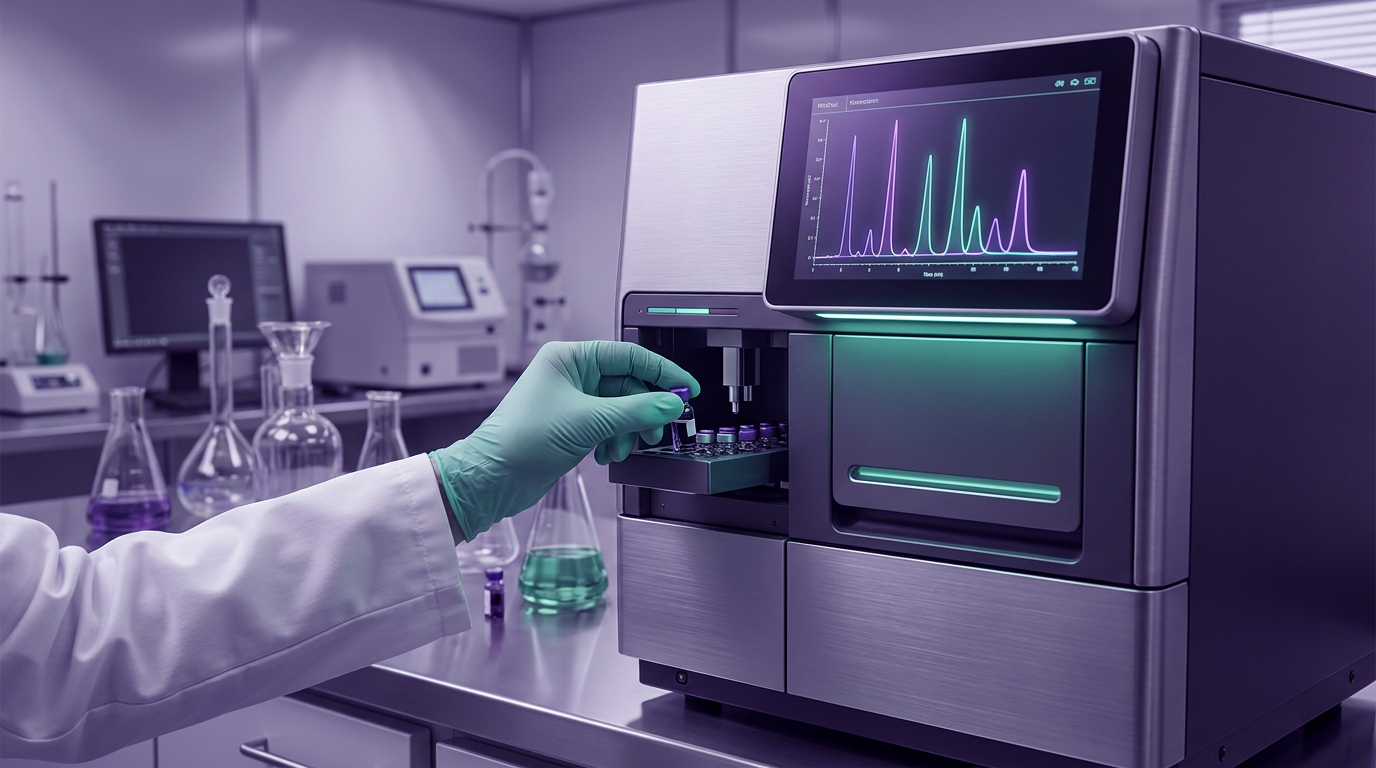
When a peptide mixture is injected onto the column, the peptides initially bind to the hydrophobic stationary phase. As the concentration of the organic solvent in the mobile phase gradually increases (gradient elution), the peptides with lower hydrophobicity elute first, followed by those with higher hydrophobicity. A detector, commonly a UV-Vis detector set to wavelengths like 214 nm (for peptide backbone) or 280 nm (for aromatic amino acids), monitors the eluent. The resulting chromatogram displays a series of peaks, each representing a separated component. The area under each peak is proportional to the concentration of that component, and the retention time is characteristic of the specific peptide under the given chromatographic conditions.
For quality control of research peptides in the UK, a high-quality HPLC chromatogram should ideally show one dominant, sharp peak representing the target peptide, with minimal other peaks (impurities) that are typically less than 1% of the main peak's area. This ensures that the bulk of the material being used in research is indeed the intended peptide.
### What the Research Shows: The Impact of Purity on Experimental Outcomes
Numerous studies across various disciplines underscore the critical importance of peptide purity, often validated by HPLC, for the integrity of research findings. Impurities in research peptides can significantly alter biological activity, specificity, and even the fundamental conclusions drawn from experiments.
* **Early reports (1980s-1990s)** on peptide synthesis and characterization frequently highlighted how minor impurities could lead to artifactual biological responses. For instance, a small percentage of a truncated or oxidized peptide might possess unexpected activity or inhibit the activity of the desired peptide, skewing dose-response curves or receptor binding studies.
* **Pharmacology and Cell Biology:** Research in pharmacology (e.g., Journal of Medicinal Chemistry, Peptides) often details the challenges of distinguishing true agonist/antagonist activity from effects caused by synthetic by-products. Experiments investigating receptor-ligand interactions, enzyme kinetics, or cell signaling pathways are particularly susceptible to impurity-related interference. A 2012 study in *Molecular Pharmacology* detailed how a commonly used peptide sequence, when insufficiently purified, exhibited non-specific cellular uptake and toxicity not attributed to the target sequence itself, entirely altering the interpretation of its potential as a therapeutic lead.
* **Structural Biology:** In applications like NMR spectroscopy or X-ray crystallography, high purity is paramount. Even small amounts of impurities can lead to broadened NMR signals, interfere with protein crystallization, or produce extraneous electron density maps, making structural determination challenging or impossible. A review in *Nature Methods* (2009) emphasized the need for >95% purity for many structural biology applications to ensure reliable data.
* **Immunology:** For developing antibodies or studying immune responses, contaminating peptides can elicit off-target immune reactions, leading to false positives or an incomplete understanding of epitope specificity. Studies published in *Immunology Today* in the early 2000s repeatedly cautioned against using unverified peptides for immunization protocols.
These examples collectively demonstrate that a high standard of HPLC purity, typically ≥95% for most research applications, and often ≥98% or even ≥99% for more sensitive studies (e.g., structural biology, in-vivo pharmacology), is not just a recommendation but a scientific necessity. Laboratories procuring research peptides in the UK must insist on transparent and verifiable purity data.
### Comparisons: HPLC vs. Other Purity Verification Methods
While HPLC is a cornerstone, other analytical methods complement or can be used alongside HPLC for comprehensive peptide characterization.
| Method | Primary Application | Strengths | Limitations | | :------------------- | :---------------------------------------- | :-------------------------------------------- | :------------------------------------------ | | **RP-HPLC** | Purity, Identity, Quantification | Excellent resolution, quantitative, sensitive | Requires chromophore, can miss isoforms | | **Mass Spectrometry (MS)** | Identity, Molecular Weight, Sequence Confirm. | High sensitivity, exact mass, sequence info | Not quantitative for purity, can miss isomers | | **Amino Acid Analysis (AAA)** | Compositional confirmation | Confirms amino acid ratios | Destructive, doesn't verify sequence/purity | | **Capillary Electrophoresis (CE)** | Purity, Charge-based separation | Good for charged impurities, high efficiency | Lower capacity than HPLC, less common |
**HPLC-MS (LC-MS)** is a particularly powerful combination, where an HPLC system is coupled directly to a mass spectrometer. This allows for both the separation (by HPLC) and the exact molecular weight determination (by MS) of each component in the mixture. This is invaluable for identifying specific impurities, such as truncated sequences (which will have different molecular weights) or post-translational modifications. For sophisticated research involving research peptides in the UK, LC-MS data alongside standard HPLC chromatograms provides the most robust purity and identity verification.
### Open Research Questions in Peptide Purity Assessment
Despite the maturity of HPLC, several open research questions and areas for improvement exist, especially concerning highly challenging peptides:
* **Difficult-to-Separate Isomers:** Peptides containing D-amino acids, or those prone to cis-trans isomerization, can be extremely difficult to resolve even with advanced HPLC techniques. Developing new stationary phases or mobile phase modifiers tailored for these separations remains an active area of research. * **Detection of Trace Impurities with Similar Hydrophobicity:** When impurities have very similar physiochemical properties to the target peptide, their separation by RP-HPLC can be challenging. Advanced 2D-HPLC methods or hyphenated techniques are being explored for enhanced resolution. * **Aggregation and Conformational Heterogeneity:** Peptides, particularly longer or amphipathic ones, are prone to aggregation. Detecting and quantifying aggregated forms using standard HPLC can be difficult, as they may elute as broad peaks or remain on the column. Size-exclusion chromatography (SEC) is typically used for this, but integrating these analyses remains a challenge for comprehensive purity assessment. * **Standardization of Purity Criteria:** While '95% purity' is a common benchmark, the precise definition and calculation can vary between suppliers and laboratories. Efforts to standardize purity reporting, perhaps incorporating orthogonal methods beyond RP-HPLC, could enhance inter-laboratory reproducibility.
### Risks and Evidence Gaps Related to Unverified Research Peptides
Working with unverified or poorly characterized research peptides carries significant risks that can undermine scientific endeavors and resource allocation.
* **Reproducibility Crisis:** One of the most significant risks is contributing to the reproducibility crisis in scientific research. If impurities are unknowingly affecting experimental outcomes, then independent laboratories using different batches of peptides (or even the same batch with varying impurity profiles) may obtain conflicting results. This wastes research funding and delays scientific progress. * **Misinterpretation of Biological Mechanisms:** An active impurity could be mistakenly attributed to the target peptide, leading to incorrect conclusions about receptor binding, signaling pathways, or enzyme function. This can send research down unproductive avenues for years. * **Safety Concerns in Pre-clinical Models:** While not therapeutic, research peptides are sometimes used in animal models. Unknown impurities could lead to unexpected toxicity or off-target effects, complicating interpretation and raising ethical concerns. * **Financial Waste:** Purchasing lower-quality, unverified peptides or repeating experiments due to unreliable initial results represents a substantial financial burden on research budgets, particularly for laboratories in the UK where funding can be competitive.
An evidence gap exists in the systematic long-term impact analysis of using low-purity peptides across large-scale research projects. While individual instances of confounding results are reported, comprehensive data on the cumulative impact on scientific progress is harder to quantify. Such studies could further underscore the economic and scientific imperative for stringent purity verification.
### Practical Laboratory Considerations for Research Peptides in the UK
For laboratories utilizing research peptides in the UK, several practical considerations regarding HPLC verification are paramount:
* **Supplier Due Diligence:** Always source research peptides from reputable suppliers who provide detailed analytical data with each batch. This should ideally include a full HPLC chromatogram (with UV trace and integration report), along with mass spectrometry data confirming molecular weight. Scrutinize these reports for any unassigned peaks or discrepancies. * **Re-verification Upon Receipt:** Even with supplier-provided data, some laboratories perform their own in-house HPLC verification, especially for critical experiments or when using a new supplier. This is prudent to account for potential degradation during shipping or differences in analytical conditions. * **Storage and Handling:** Proper storage (e.g., lyophilized, desiccated, at -20°C or -80°C) and handling (e.g., reconstitution with appropriate solvents, aliquotting to minimize freeze-thaw cycles) are crucial to maintain peptide purity over time. Regular re-analysis via HPLC is recommended for long-term stored peptide stocks. * **Method Optimization:** For laboratories performing in-house HPLC, optimizing the chromatographic method (e.g., choice of column, gradient, mobile phase additives) can be critical for achieving optimal resolution and accurate purity assessment, especially for challenging sequences. Consult relevant literature or method development guides. * **Trained Personnel:** Operating and interpreting HPLC data requires trained personnel. Misinterpretation of chromatograms (e.g., incorrectly assigning impurity peaks, ignoring shoulder peaks) can negate the purpose of verification.
### FAQ: HPLC Verification for Research Peptides
### What is the typical purity standard for research peptides?
For most general research applications, a purity of ≥95% as determined by RP-HPLC is considered acceptable. However, highly sensitive applications like structural biology, in-vivo studies, or receptor-binding assays often demand ≥98% or even ≥99% purity to ensure the integrity of results.
### Can HPLC identify specific impurities in a peptide sample?
RP-HPLC primarily separates components based on hydrophobicity, allowing for quantification of the main product versus impurities. While it shows the presence of impurities, it doesn't directly identify their chemical structure. Coupling HPLC with Mass Spectrometry (LC-MS) is the definitive method for identifying specific impurities by determining their exact molecular weight.
### How often should research peptides be re-verified by HPLC?
The frequency of re-verification depends on storage conditions, peptide stability, and the criticality of the experiment. For long-term stored stock solutions or lyophilized peptides used over extended periods, re-analysis every 6-12 months is advisable. If there's any doubt about the peptide's integrity (e.g., changes in appearance, unexpected experimental results), immediate re-verification is recommended.
### Is it always necessary to run my own in-house HPLC verification?
While not always strictly necessary if working with highly reputable suppliers who provide comprehensive and transparent analytical reports, performing in-house HPLC verification offers an extra layer of quality assurance. It's particularly recommended for critical experiments, when using a new supplier, or if batch-to-batch variability is a concern. Many UK research institutions have core facilities that can provide this service.
### What are the main challenges in performing HPLC verification for peptides?
Key challenges include optimizing methods for highly hydrophobic or hydrophilic peptides, resolving closely related impurities (e.g., deamidation products, deletion sequences with similar retention times), preventing peptide aggregation on the column, and ensuring consistent instrument performance. The choice of column chemistry, mobile phase modifiers, and gradient parameters are crucial for overcoming these challenges.
### Conclusion: The Indispensable Role of HPLC in Research Peptides UK Laboratories
For any laboratory involved in cutting-edge research, particularly those utilizing research peptides in the UK, meticulous HPLC verification is not an optional extra; it is an indispensable component of quality control and good scientific practice. The robust separation capabilities of HPLC, especially when combined with orthogonal techniques like mass spectrometry, provide the necessary assurance that the peptide being studied is indeed the intended molecule, free from confounding impurities. Investing in high-purity, HPLC-verified research peptides ultimately translates to more reliable data, accelerated discovery, and a stronger foundation for scientific advancement. Overlooking this critical step introduces significant risks to reproducibility, accurate interpretation, and the efficient allocation of research resources. The ongoing evolution of analytical methodologies continues to refine our ability to characterize these complex biomolecules, further cementing HPLC's pivotal role in the peptide research landscape.
Educational reference only — in-vitro research use only.