
Metabolic Research
Semaglutide vs Tirzepatide: A Research-Grade Comparison
·Educational reference
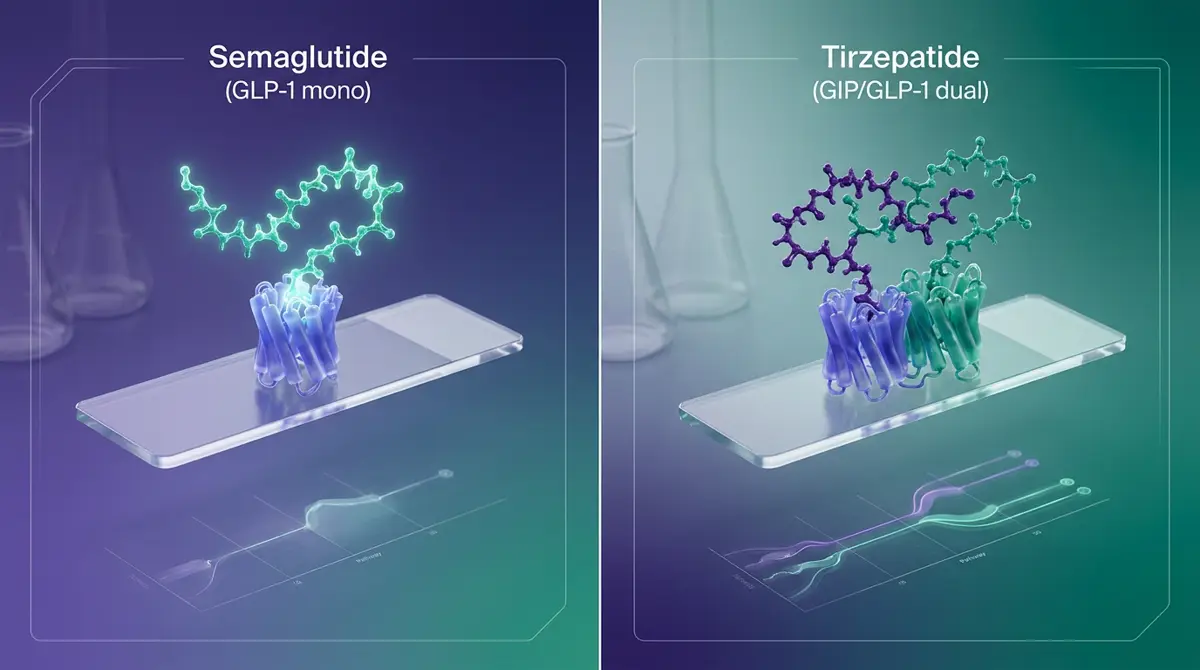
Semaglutide and Tirzepatide are the two most widely referenced incretin peptides in current metabolic-research literature. Both are long-acting, both target the GLP-1 receptor, and both are lyophilised reference standards commonly held by laboratories characterising glucose homeostasis, satiety signalling and energy substrate handling.
The critical pharmacological difference is receptor engagement. Semaglutide is a selective GLP-1 receptor agonist derived from native GLP-1(7-37) with amino-acid substitutions and a C18 fatty diacid chain that binds albumin and extends half-life to roughly 165 hours. Tirzepatide adds glucose-dependent insulinotropic polypeptide (GIP) receptor agonism into the same molecule, producing a dual GIP/GLP-1 agonist with a similar once-weekly kinetic profile.
In head-to-head preclinical work, dual GIP/GLP-1 agonism has been associated with additive effects on insulin sensitivity, adipose-tissue substrate handling and body-weight endpoints in obesity models. Whether the effect is truly additive or whether GIP contributes primarily through adipose-tissue signalling remains an active research question — one that reference standards from a single, well-characterised source help isolate.
For a comparative bench design, matching batch documentation matters more than usual. Both peptides should arrive with HPLC purity above 98%, mass-spec identity confirmation and a batch certificate of analysis so cross-compound comparisons are not confounded by variable input material.
Researchers often extend this comparison to Retatrutide (GIP/GLP-1/glucagon triple agonist) to map the full incretin-plus-glucagon receptor landscape. Together the three compounds form the current reference set for the incretin-pharmacology comparative literature.
Everything above is educational reference material. Both compounds are supplied strictly as chemical reference standards for in-vitro and laboratory-animal research, not for human or veterinary use.
Further reading on Peptide Intel Hub: verified research suppliers, how to read a certificate of analysis, every protocol from A to Z.