
Regenerative Research
BPC-157 Peptide Research: What the Tissue-Repair Literature Shows
·Educational reference
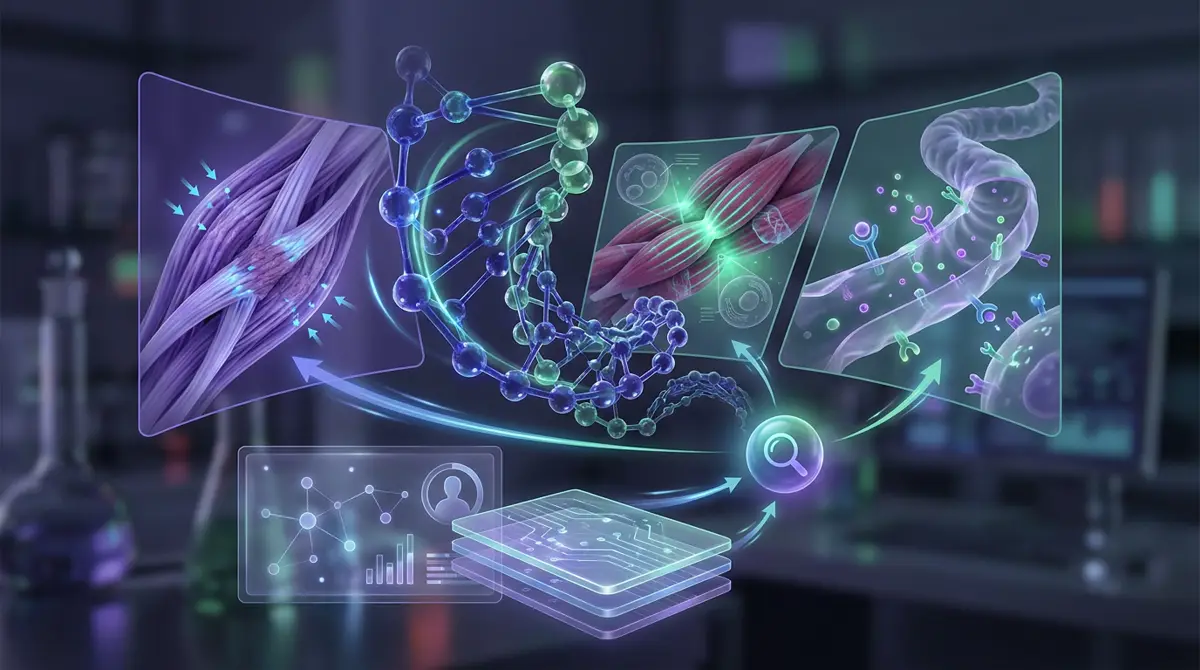
BPC-157 (Body Protection Compound-157) is a synthetic 15-amino-acid peptide (a pentadecapeptide) based on a partial sequence of a protein found in human gastric juice. Most of what is known about it comes from rodent and cell-culture studies of tendon, ligament, muscle and gastrointestinal repair. This review sets out what those studies tested, what they reported, and — just as important — where the evidence stops.
Quick answer: what does the research show?
In short: a consistent body of animal and in-vitro work reports faster or more complete healing in repair models, but there are no completed, published randomised controlled trials in humans. The human evidence is limited to a small retrospective case series. Animal findings cannot be read as proof of effect in people.
Evidence at a glance
Animal studies (rats): the largest group, covering transected and detached Achilles tendons, muscle injury and gastric or intestinal lesions. In-vitro studies: tendon fibroblasts and endothelial cells, used to probe mechanisms such as cell migration and blood-vessel signalling. Reviews: narrative reviews summarise the musculoskeletal literature. Human data: one retrospective report of intra-articular injections for knee pain, with no control group.
Tendon and ligament repair models
The most cited work is in tendon healing. Krivic and colleagues (J Orthop Res, 2003) reported that BPC-157 accelerated healing of transected rat Achilles tendons and stimulated tendon-cell (tendocyte) growth in vitro. A follow-up from the same group (J Orthop Res, 2006) reported improved tendon-to-bone healing after Achilles detachment and a reduction of the impairment caused by corticosteroids. Both are rat studies from a single research group, which is a recognised limitation of this literature.
Chang and colleagues (J Appl Physiol, 2011) looked at mechanism in tendon explants and fibroblasts, reporting increased tendon outgrowth, cell survival and cell migration. A 2026 rat study (Jt Dis Relat Surg) compared BPC-157, TB-500 and their combination for Achilles tendon healing, assessed histologically and biomechanically — one of the few studies to test the two compounds side by side.
Proposed mechanisms
Hsieh and colleagues (J Mol Med, 2017) linked BPC-157's pro-angiogenic activity to activation and up-regulation of VEGFR2, a receptor central to new blood-vessel formation — a plausible route to better-supplied granulation tissue. Other preclinical papers point to effects on the nitric oxide system and on fibroblast migration. These are proposed mechanisms from laboratory models, not established pathways in humans.
Muscle and soft-tissue reviews
Gwyer, Wragg and Wilson (Cell Tissue Res, 2019) reviewed BPC-157's role in musculoskeletal soft-tissue healing. They summarised consistently positive results in rodent models of tendon, ligament and muscle injury, and they stressed that human studies were needed before any clinical conclusions could be drawn.
Gastrointestinal research
Because the sequence comes from a gastric protein, much of the early work studied the gut: stress-induced lesions, NSAID-induced ulceration and models resembling inflammatory bowel disease. Many studies report that BPC-157 remains stable in gastric juice and is active by both oral and injected routes in animals, which sets it apart from many short peptides that break down quickly.
What about human studies?
The human evidence is very thin. Lee and Padgett (Altern Ther Health Med, 2021) described a retrospective series of patients given intra-articular BPC-157 for several types of knee pain. It had no control group, no blinding and a small sample, so it cannot establish whether the peptide caused any change. ClinicalTrials.gov lists few BPC-157 registrations, and as of this review no randomised controlled trial results have been published.
Limitations to keep in mind
Much of the literature comes from one research group, and independent replication is limited. Most studies are in rats, and the dose, route and outcome measures vary between papers. Publication bias towards positive results is possible. BPC-157 is not an approved medicine in the UK, EU or US, and nothing here is a recommendation for human use.
Practical notes for laboratory researchers
Reference-grade BPC-157 is supplied freeze-dried (lyophilised). Before any bench work, confirm identity by mass spectrometry, confirm purity by HPLC and check the batch certificate of analysis. Our protocol page lists the literature-reported ranges and the reconstitution maths with 3 ml bacteriostatic water, and our BPC-157 vs TB-500 comparison covers how the two are studied together.
This article is an educational evidence review for researchers. It is not medical advice, a protocol or a dosing recommendation.
Further reading on Peptide Intel Hub: verified research suppliers, how to read a certificate of analysis, every protocol from A to Z.