
Peptide Intel Hub

Longevity Research

MOTS-c: The Mitochondrial-Derived Peptide in Metabolic and Longevity Research

·Educational reference
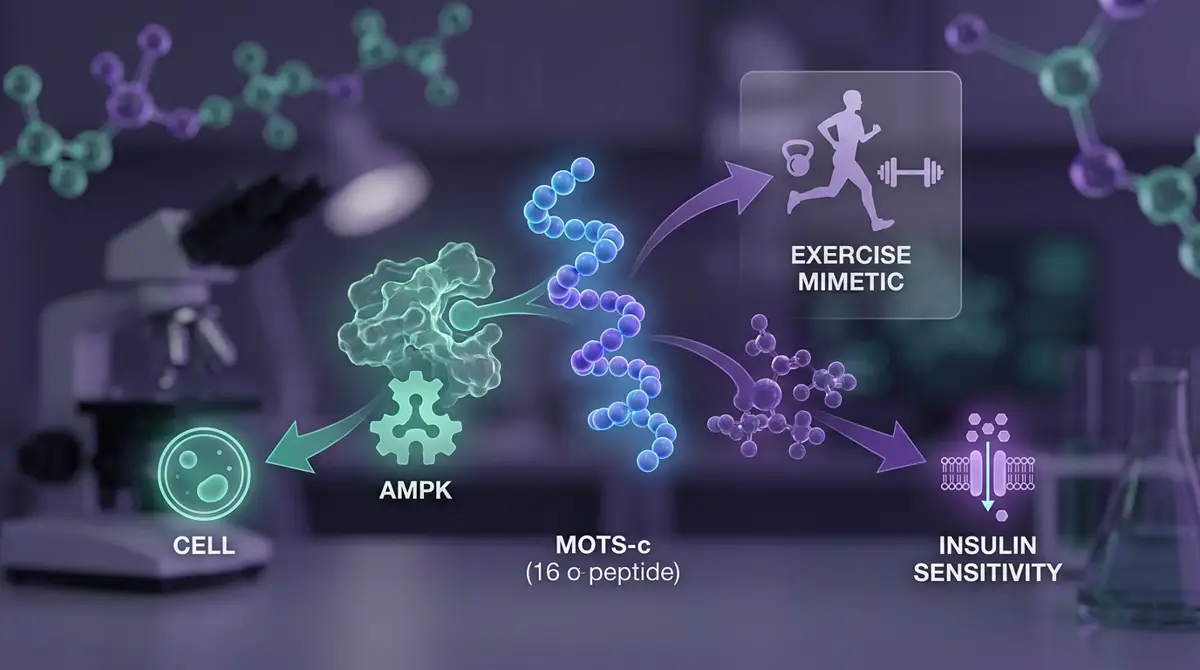
Illustration for MOTS-c: The Mitochondrial-Derived Peptide in Metabolic and Longevity Research
Share

MOTS-c (Mitochondrial ORF of the Twelve S rRNA-c) is a 16-amino-acid peptide encoded within the mitochondrial 12S rRNA gene. Since its discovery, MOTS-c has become one of the most-cited examples of a mitochondrial-derived peptide with signalling activity outside the mitochondrion itself.

Mechanistically, MOTS-c has been shown in cell-culture and rodent work to activate AMP-activated protein kinase (AMPK), influencing folate metabolism, insulin sensitivity and glucose handling. Research designs frequently pair it with metformin as a comparator small-molecule AMPK-adjacent reference.

Longevity-adjacent research interest stems from the observation that MOTS-c circulating levels decline with age and that exogenous administration in rodent models has reproduced several exercise-associated phenotypes, including improved metabolic flexibility. This positions MOTS-c as a candidate 'exercise-mimetic' reference peptide.

From a research-practice standpoint, MOTS-c is a small, water-soluble peptide that reconstitutes readily in bacteriostatic water. Reference-grade material should arrive with HPLC purity confirmation above 98%, mass-spectrometry identity and a batch certificate of analysis.

Comparative designs commonly place MOTS-c alongside NAD+ precursors (NMN, NR), Epitalon and the growing set of mitochondrial-targeted small molecules to map convergent effects on age-associated pathways.

MOTS-c is supplied strictly as a chemical reference standard for in-vitro and laboratory-animal research. This article is educational reference material and is not a recommendation for human use.

Further reading on Peptide Intel Hub: verified research suppliers, how to read a certificate of analysis, every protocol from A to Z.

Share

More in Longevity Research

© 2026 Peptide Intel Hub · Educational research reference · For in-vitro research use only

Verified suppliers

Where researchers source the compounds we cover

We are an independent publication — we sell nothing, hold no stock and take no payment. When you have finished reading, these are the suppliers we have checked for lot-matched third-party certificates of analysis.

View verified suppliers Independent directory · External supplier websites
  1. 1 · Plan the bench work

    Work out reconstitution volumes and concentrations before ordering, so you buy the vial size your protocol actually needs.

    Reconstitution calculator
  2. 2 · Check the paperwork

    Only use material released with a lot-matched third-party certificate of analysis.

    Batch certificates
  3. 3 · Verified suppliers

    How we verify, what each supplier publishes and which regions they serve.

    Supplier directory

Outbound supplier links are marked nofollow/sponsored. Compounds discussed are laboratory research reagents, not medicines. Listing is not an endorsement or medical advice.

Independent publication — we sell nothing. Supplier disclosure

Peptide Intel Hub is an independent educational publication. We are not affiliated with, owned by, or the same company as Biomech Peptides and Regena.app (biomechpeptides.com / regena.app). We do not sell, supply, ship or take payment for any compound. Because readers regularly ask where compounds discussed in published studies can be sourced for laboratory work, we list Biomech Peptides and Regena.app as suppliers we have verified and trust — every batch is released with a lot-matched third-party certificate of analysis (HPLC purity and mass-spectrometry identity). Outbound links are marked nofollow/sponsored and are provided to help readers, not to sell.