
Regenerative Research
Cold-Chain Storage for Research Peptides: A Practical Bench Guide
·Educational reference
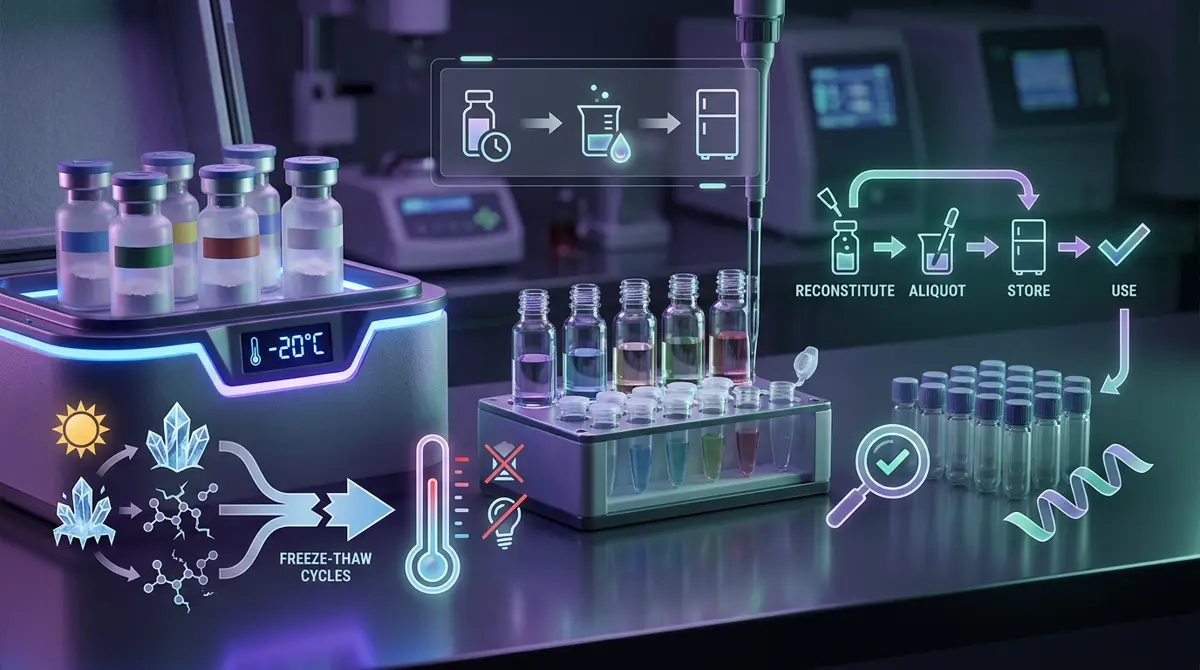
Reference peptides are among the more storage-sensitive materials on a laboratory bench. Getting storage wrong is one of the most common causes of unexplained variance in peptide-research assays — before questioning a receptor pathway or a study design, most experienced laboratories check the storage log.
Lyophilised (freeze-dried) peptides are the most stable form. Stored at −20 °C in a sealed vial, protected from light and moisture, most sequences remain within specification for 24 months or longer. Ultra-low temperature (−80 °C) extends shelf life further for long-term reference material but is rarely required for active study material.
Reconstituted material is far more delicate. Depending on the peptide, sequence stability in bacteriostatic water at 2-8 °C ranges from about 7 days for the most labile sequences to 28-45 days for the most stable. Once reconstituted, vials should be kept upright, protected from light, and not allowed to warm to room temperature between uses. A single warm-cold cycle typically does not damage the peptide; repeated cycling does.
Freeze-thaw damage is cumulative. Ice-crystal formation during freezing can physically fragment peptide bonds in aqueous solution, and aggregation on thawing further reduces active concentration. The recommended practice is to aliquot reconstituted stock into single-use volumes immediately after reconstitution, freeze at −20 °C, and thaw only what is needed for that experimental session.
Light exposure is a specific concern for peptides containing tryptophan, tyrosine or methionine residues, and for copper-complexed peptides such as GHK-Cu. Amber vials and dark refrigerator storage are standard for these sequences.
Documentation ties it all together: every vial should be labelled with peptide name, batch number, reconstitution date and solvent used. This lets a downstream anomaly — an unexpected assay result, a variance in a dose-response — be traced back to the specific material used, which is a foundation of reproducibility in peptide research.
This article is intended as bench-side educational guidance for laboratory researchers and does not describe human or veterinary use.
Further reading on Peptide Intel Hub: verified research suppliers, how to read a certificate of analysis, every protocol from A to Z.